Indianapolis Colts vs New York Jets Match Player Stats: A Complete Breakdown (Nov 17 2024)

The matchup between the Indianapolis Colts and the New York Jets on November 17, 2024, at MetLife Stadium was a high-stakes encounter that kept fans on the edge of their seats until the final seconds. Coming into Week 11, the Colts were looking to snap a three-game losing streak and keep their playoff hopes alive, while the New York Jets, led by veteran Aaron Rodgers, were desperate to turn around a season that had largely underwhelmed despite immense preseason hype. The game served as a redemption arc for Anthony Richardson, the Colts’ young quarterback who had been benched in previous weeks for Joe Flacco. His return to the starting lineup was the primary narrative surrounding this contest, and the pressure was on him to prove he could lead a productive NFL offense against a stout Jets defensive front.
The final score of 28-27 in favor of the Colts tells the story of a back-and-forth battle where every possession mattered. The Jets started incredibly slow, failing to secure a single first down for a significant portion of the first half, while the Colts capitalized on early opportunities to build a 13-0 lead. However, the momentum shifted dramatically in the second half as the Jets found their rhythm, eventually taking a late lead in the fourth quarter. The game was ultimately decided by Richardson’s late-game heroics, including a game-winning 4-yard touchdown run with only 46 seconds remaining. This victory not only improved the Colts’ record to 5-6 but also highlighted the systemic issues within the Jets’ roster and coaching staff as they fell further out of contention.
Anthony Richardson Player Stats and Performance
Anthony Richardson’s performance in this game was nothing short of spectacular, marking perhaps the most complete game of his young career. After sitting out for two games, Richardson returned with a sense of urgency and poise that had been missing in earlier weeks. He completed 20 of his 30 pass attempts for a career-high 272 yards, showing significant improvement in his accuracy and decision-making. His ability to deliver the ball to his playmakers in tight windows was evident, especially during the game-winning drive where he hit Alec Pierce and Josh Downs for crucial gains. His 106.5 passer rating was a testament to his efficiency, but it was his dual-threat capability that truly broke the Jets’ defense.
On the ground, Richardson was equally effective, recording 32 rushing yards on 10 carries and scoring two critical rushing touchdowns. His first touchdown was a 2-yard plunge in the second quarter that helped the Colts establish their early dominance. However, it was his 4-yard scramble for the winning score that defined the night. Richardson’s 6-foot-4, 244-pound frame allowed him to shrug off blitzing defenders and force his way into the end zone. By the end of the game, it was clear that the coaching staff’s decision to start him again had paid off, as he accounted for three total touchdowns and provided the spark the Indianapolis offense had been missing.
Aaron Rodgers Match Stats for New York Jets
On the other side of the field, the veteran Aaron Rodgers had a game of two halves. The 40-year-old quarterback struggled mightily in the first quarter, as the Jets’ offense looked stagnant and disorganized. He was just 9 of 13 for 76 yards for much of the first half, and the team faced multiple punts due to an inability to convert third downs. However, Rodgers showed flashes of his Hall-of-Fame brilliance in the second half, orchestrating scoring drives that put the Jets back in the game. He finished the afternoon with 22 completions on 29 attempts for 184 passing yards and two touchdowns. While his yardage was low by his standards, his efficiency was high, reflected in a passer rating of 114.7.
Rodgers’ touchdowns to Breece Hall and Kenny Yeboah gave the New York faithful hope that they could pull off a comeback victory. He managed the pocket well for most of the second half, finding Davante Adams for key conversions. However, the game ended on a sour note for the veteran as he was sacked twice by Kwity Paye on the final drive, effectively ending the Jets’ chances of a last-second field goal. Despite passing Dan Marino for eighth place on the NFL’s all-time passing yardage list during this game, the individual milestone was overshadowed by the team’s inability to close out the game at home.
Team Comparison: Total Yards and Efficiency
Match Team Stats Table
| Team Statistic | Indianapolis Colts | New York Jets |
| Final Score | 28 | 27 |
| Total Net Yards | 332 | 253 |
| First Downs | 18 | 10 |
| Rushing Yards | 91 | 91 |
| Passing Yards | 241 | 162 |
| Time of Possession | 34:17 | 25:43 |
| Sacks Allowed | 2 | 3 |
| Fumbles Lost | 1 | 0 |
| Penalties-Yards | 5-40 | 2-14 |
Looking at the team statistics, the Colts were clearly the more dominant offensive unit for the majority of the game. They outpaced the Jets in total yards, 332 to 253, and nearly doubled them in first downs (18 to 10). A major factor in the Colts’ victory was their control over the clock; Indianapolis held the ball for over 34 minutes, leaving Aaron Rodgers and the Jets’ offense on the sideline for extended periods. This ball control was a deliberate strategy by head coach Shane Steichen to limit the number of possessions for the Jets’ explosive playmakers like Garrett Wilson and Davante Adams.
While the rushing yards ended in an identical 91-91 tie, the way those yards were gained differed significantly. The Colts relied heavily on Jonathan Taylor’s volume, though he found running lanes difficult to come by. The Jets, meanwhile, relied on the explosiveness of Breece Hall. In terms of efficiency, the Colts converted 6 of 15 third downs, whereas the Jets managed 4 of 13. The disparity in passing yards (241 to 162) highlighted Anthony Richardson’s success in pushing the ball downfield compared to Rodgers’ more conservative, short-passing approach for much of the game.
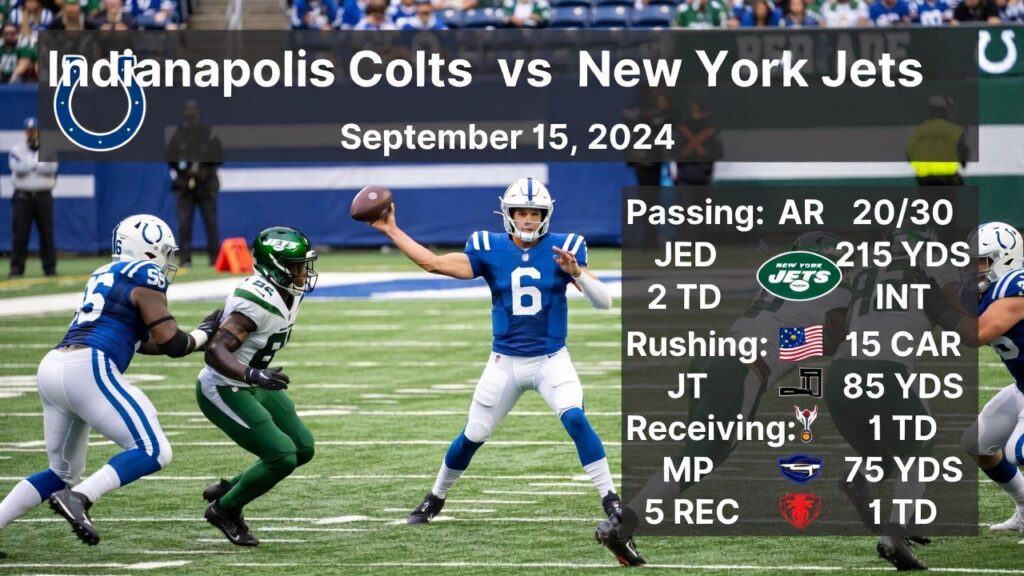
Jonathan Taylor Rushing Breakdown
Jonathan Taylor entered the game as the focal point of the Jets’ defensive game plan, and it showed. The star running back was consistently met by a wall of green jerseys at the line of scrimmage. Taylor finished with 57 rushing yards on 24 carries, averaging a meager 2.4 yards per attempt. While his yardage totals were not eye-popping, his presence was vital in keeping the defense honest and allowing the play-action passing game to develop for Richardson. Taylor’s workload was essential for wearing down the Jets’ defensive front, even if he didn’t find the end zone or break off any long runs.
In addition to his rushing duties, Taylor was targeted in the passing game, though he only recorded one catch for 3 yards. He also had a crucial role in the late-game strategy, including an unsuccessful two-point conversion attempt that kept the score at 28-27. Despite the lack of big plays, Taylor’s ability to grind out tough yards on early downs helped the Colts maintain their time-of-possession advantage. His reliability as a ball carrier ensured that the Colts didn’t suffer any turnovers in the backfield, providing a stable floor for the offense to operate.
Breece Hall Player Stats: The Jets’ Bright Spot
Breece Hall was undoubtedly the most productive player for the New York Jets on offense. He accounted for 121 total yards and two touchdowns, proving why he is considered one of the most versatile backs in the league. Hall rushed 16 times for 78 yards, including a brilliant 18-yard touchdown run in the third quarter that gave the Jets their first lead of the game. His vision and burst were on full display as he navigated through the Colts’ defensive line, often making the first defender miss to gain extra yardage.
Hall was equally dangerous as a receiver out of the backfield, leading the Jets with 7 receptions for 43 yards and a touchdown. His 29-yard catch-and-run touchdown in the second quarter was the spark the Jets needed to get back into the game after their scoreless start. Hall’s ability to turn a simple check-down pass into a scoring play kept the New York offense afloat when Rodgers was struggling to find his wide receivers. Despite his heroic efforts, the lack of support from the rest of the running game (the Jets only had 13 non-Hall rushing yards) made the offense too predictable in the closing stages.
Wide Receiver Stats: Josh Downs and Alec Pierce
Colts Receiving Stats Table
| Player | Targets | Receptions | Yards | Average | TD |
| Josh Downs | 5 | 5 | 84 | 16.8 | 1 |
| Alec Pierce | 4 | 3 | 74 | 24.7 | 0 |
| Michael Pittman | 8 | 5 | 46 | 9.2 | 0 |
| Adonai Mitchell | 2 | 1 | 33 | 33.0 | 0 |
The Colts’ receiving corps stepped up in a big way to support Anthony Richardson. Josh Downs was the most reliable target, catching all 5 of his targets for 84 yards and a touchdown. His 10-yard scoring grab in the fourth quarter was a highlight-reel play, as he found a soft spot in the zone and secured the ball through contact. Downs has quickly become Richardson’s “go-to” guy on third downs, using his speed and route-running ability to create separation consistently against the Jets’ secondary.
Alec Pierce once again proved his worth as one of the NFL’s premier deep threats. Pierce caught 3 passes for 74 yards, including a massive 39-yard reception on the final drive that flipped the field and put the Colts in scoring position. Pierce’s ability to win 50/50 balls down the sideline was a nightmare for the Jets’ cornerbacks all afternoon. Michael Pittman Jr. also contributed with 5 catches for 46 yards, providing a veteran presence in the middle of the field. The diversity of the Colts’ passing attack made it difficult for the Jets to focus on any single player, allowing Richardson to spread the wealth effectively.
New York Jets Passing Attack: Davante Adams and Garrett Wilson
The duo of Davante Adams and Garrett Wilson was expected to dominate, but the Colts’ secondary, led by Kenny Moore II, did a commendable job of containing them. Davante Adams led the Jets’ receivers with 6 catches for 72 yards, showing good chemistry with Rodgers on slant routes and intermediate patterns. His 24-yard reception in the fourth quarter helped set up a touchdown, but he was largely held out of the end zone. Adams’ veteran savvy was evident, but the lack of consistent protection for Rodgers meant that many of his routes didn’t have time to develop.
Garrett Wilson had a quieter night by his standards, finishing with 4 receptions for just 18 yards. This was a significant win for the Colts’ defense, as Wilson is typically a high-volume target capable of breaking a game open. The Jets’ inability to get Wilson involved in space limited their offensive ceiling. Other contributors included tight end Kenny Yeboah, who caught his first career touchdown—an 11-yard pass from Rodgers—and Xavier Gipson, who had a critical 17-yard catch on a third-and-14. Overall, the Jets’ passing game felt fragmented, lacking the rhythm seen in the third and fourth quarters during their comeback attempt.
Defensive Leaders: Kwity Paye’s Game-Ending Sacks
The defensive player of the game for Indianapolis was undoubtedly Kwity Paye. The edge rusher was a constant thorn in the side of the Jets’ offensive line, providing consistent pressure on Aaron Rodgers. Paye saved his best for last, recording two sacks on the final drive of the game. With the Jets needing a field goal to win, Paye blew past the offensive tackle and took Rodgers down, forcing a fumble on the first play (which the Jets recovered). A few plays later, he ended the contest with another sack, sealing the 28-27 victory. Paye finished the game with 6 solo tackles and 2 sacks.
The Colts’ defensive unit as a whole played with great discipline in the first half, completely shutting down the Jets’ run and pass game. E.J. Speed and Zaire Franklin were active in the middle, combining for several tackles for loss. While they did allow 27 points, much of that came in the third quarter when the defense was fatigued due to a quick turnaround after a Richardson fumble. However, their ability to bend but not break in the final minutes proved to be the difference. They forced the Jets into difficult third-down situations and capitalized when Rodgers was forced to hold the ball.
Jets Defense: Jamien Sherwood and Quinnen Williams
Jamien Sherwood was a standout for the New York Jets defense, leading the team in tackles and providing one of the game’s biggest momentum shifts. In the third quarter, Sherwood executed a strip-sack on Anthony Richardson, which was recovered by Javon Kinlaw deep in Colts territory. This turnover led directly to a Breece Hall touchdown, allowing the Jets to take their first lead. Sherwood has emerged as a reliable linebacker for New York, showing an ability to cover ground and tackle effectively in the open field.
Quinnen Williams also made his presence felt on the interior. The All-Pro defensive tackle recorded a sack on Richardson and was a major reason why Jonathan Taylor was limited to just 2.4 yards per carry. Williams’ strength and technique allowed him to disrupt the Colts’ blocking schemes frequently. Despite these individual efforts, the Jets’ defense struggled to contain the Colts on the final, game-winning drive. They allowed explosive plays to Alec Pierce and Josh Downs when they needed a stop the most, ultimately failing to protect the one-score lead given to them by the offense.
Special Teams: Matt Gay vs Anders Carlson
Kicking Stats Table
| Kicker | Team | FGM | FGA | Long | Points |
| Matt Gay | Colts | 3 | 3 | 56 | 9 |
| Anders Carlson | Jets | 2 | 2 | 58 | 8 |
Special teams played a massive role in this one-point game. Matt Gay was perfect for the Colts, converting all three of his field goal attempts. His 56-yarder in the third quarter was particularly impressive, giving the Colts a temporary lead and demonstrating his range in the open-air MetLife Stadium. Gay’s consistency has been a hallmark of his career, and in a game decided by a single point, his performance was essential. His ability to consistently provide points when the offense stalled in the red zone kept the Colts within striking distance throughout the second half.
For the Jets, Anders Carlson had a career night. Called up from the practice squad just a day before the game, Carlson converted a career-long 58-yard field goal in the third quarter that momentarily silenced the critics of the Jets’ kicking situation. He also hit a 35-yarder in the fourth quarter to extend the Jets’ lead to five points. However, the missed opportunity on a two-point conversion by the Colts earlier in the game actually worked in the Jets’ favor statistically, but the special teams unit couldn’t overcome the defensive lapses late in the game. Carlson proved he belongs on an active roster with his clutch kicking.
Final Match Leaders Summary
| Category | Player (Colts) | Stats | Player (Jets) | Stats |
| Passing | A. Richardson | 272 Yds, 1 TD | A. Rodgers | 184 Yds, 2 TD |
| Rushing | J. Taylor | 57 Yds, 24 Car | B. Hall | 78 Yds, 1 TD |
| Receiving | J. Downs | 84 Yds, 1 TD | D. Adams | 72 Yds, 0 TD |
| Defense | K. Paye | 6 Solo, 2 Sacks | J. Sherwood | 7 Tackles, 1 Sack |
Red Zone Efficiency and Key Penalties
Red zone efficiency was a tale of two different approaches. The Colts were successful in finishing their drives with touchdowns when they got close, largely thanks to Richardson’s legs. They went for two-point conversions twice and failed both times, which kept the game much closer than the yardage totals would suggest. On the other hand, the Jets struggled in the red zone during the first half but became more efficient as the game progressed. Breece Hall was the primary red-zone weapon for New York, scoring both on the ground and through the air from inside the 20-yard line.
Penalties also played a role in swinging the momentum. The Colts were flagged 5 times for 40 yards, including a fair-catch interference penalty on Ashton Dulin that gave the Jets excellent field position, leading to an Anders Carlson field goal. The Jets were more disciplined, only committing 2 penalties for 14 yards. However, a delay-of-game penalty on the Colts’ E.J. Speed during the Jets’ final drive gave New York a 5-yard boost, though they were unable to capitalize on the gift. Discipline in high-pressure moments was a recurring theme for both coaching staffs.
First Half Analysis: Colts Dominance
The first half was a masterclass in defensive execution by the Colts. They held the Jets to zero first downs until just before the two-minute warning of the second quarter. The Jets’ offense looked completely lost, with Aaron Rodgers appearing out of sync with his receivers. Meanwhile, the Colts used a balanced attack to jump out to a 13-0 lead. Anthony Richardson scored his first rushing touchdown and Matt Gay added two field goals. The Colts controlled the line of scrimmage, and it felt as though the game might turn into a blowout early on.
However, the Jets managed to steal some momentum right before halftime. Breece Hall’s 29-yard touchdown catch capped an 8-play, 76-yard drive that seemingly came out of nowhere. This score cut the lead to 13-7 and gave the MetLife Stadium crowd something to cheer for heading into the locker room. The first half proved that while the Colts were the better-prepared team, the Jets possessed the individual talent to score quickly if given an opening. This set the stage for a dramatic second-half turnaround that saw multiple lead changes.
Second Half Turnaround: Jets Comeback
The third quarter belonged to the New York Jets. It started with a bang when Jamien Sherwood forced a fumble from Anthony Richardson on the Colts’ second offensive snap. Breece Hall quickly turned that turnover into an 18-yard rushing touchdown, giving the Jets their first lead at 14-13. The momentum had completely shifted, and suddenly the Colts’ offense, which had been so efficient in the first half, was struggling to protect the football. The Jets’ defense played with renewed energy, swarming the ball and making life difficult for Richardson.
The teams traded field goals throughout the rest of the third quarter, with Matt Gay hitting from 56 yards and Anders Carlson responding with his 58-yard bomb. By the start of the fourth quarter, the Jets had built a 24-16 lead thanks to a touchdown pass from Rodgers to Kenny Yeboah. It was a remarkable comeback for a team that had zero yards on their first nine plays of the game. The Jets’ ability to exploit the Colts’ defensive fatigue and capitalize on turnovers was the key to their surge, but they were ultimately unable to sustain it through the final whistle.
Critical Play: The Game-Winning Drive
With 2:41 remaining in the game and the Jets leading 27-22, the stage was set for Anthony Richardson’s most significant career moment to date. Starting from his own 30-yard line, Richardson displayed the poise of a veteran. On a crucial second-and-6, he unleashed a perfect “pump-fake go ball” to Alec Pierce for a 39-yard gain, moving the Colts deep into Jets territory. He followed this up with a 17-yard completion to Josh Downs, setting up a first-and-goal. The execution on this drive was flawless, as Richardson made the right reads and delivered accurate passes under immense pressure.
The drive culminated in a 4-yard rushing touchdown by Richardson. Seeing no open receivers, the quarterback tucked the ball and powered through defenders into the end zone. Although the subsequent two-point conversion failed, the Colts held a 28-27 lead with 46 seconds left. This drive silenced the doubters who questioned Richardson’s accuracy and late-game decision-making. It was an 8-play, 70-yard march that saved the Colts’ season and proved that the young signal-caller has the “clutch” factor necessary to succeed in the NFL.
Final Seconds and Kwity Paye’s Heroics
The Jets still had 46 seconds and no timeouts to attempt a game-winning field goal. However, Aaron Rodgers was never able to get the offense into scoring range. On the very first play of the drive, Kwity Paye beat his blocker and sacked Rodgers, causing a fumble. While the Jets recovered, the loss of yardage and the ticking clock put them in a desperate situation. Rodgers attempted a lateral to Tyler Conklin that fell short, and the Jets were forced to hurry to the line for a final play.
The game ended as it began for the Jets—with a sack. Kwity Paye once again reached Rodgers, dragging him down as time expired. The Colts’ sideline erupted in celebration as they secured a hard-fought 28-27 victory. The defensive stand in the final minute was a testament to the unit’s resilience. Despite giving up a lead in the second half, they came up big when it mattered most. For the Jets, the ending was a frustrating reminder of their season-long struggles with pass protection and closing out games in the fourth quarter.
Impact on Standings: AFC Playoff Race
This victory was massive for the Indianapolis Colts in the context of the AFC playoff race. By improving to 5-6, they remained in the hunt for a Wild Card spot, snapping a three-game skid that had threatened to derail their season. The win gave the team a much-needed boost of confidence heading into the final stretch of the schedule. More importantly, it solidified Anthony Richardson as the unquestioned starter moving forward, ending the quarterback controversy that had been brewing in Indianapolis.
For the New York Jets, the loss was catastrophic. Falling to 3-8, they effectively saw their slim playoff hopes vanish. The loss was their seventh in eight games, highlighting the deep-seated issues that led to the firing of Robert Saleh earlier in the season. Under interim coach Jeff Ulbrich, the team has struggled to find consistency on either side of the ball. The defeat at MetLife Stadium served as a low point in a season that began with Super Bowl aspirations, leaving the organization and the fans searching for answers as they look toward a likely offseason of significant changes.
Anthony Richardson vs Aaron Rodgers: A Contrast in Styles
The game provided a fascinating contrast between the NFL’s oldest starting quarterback, Aaron Rodgers, and one of its youngest, Anthony Richardson. Rodgers played a methodical, cerebral game, relying on his pre-snap reads and quick releases. His performance in the second half showed that he still possesses the talent to lead a winning drive, but his lack of mobility at age 40 made him vulnerable to the Colts’ pass rush when it mattered most. He finished with a high passer rating but couldn’t provide the big-play ability needed to overcome the Colts’ offense.
Richardson, conversely, used his raw athleticism and elite arm strength to overcome mistakes. While he had a costly fumble and some shaky moments in the third quarter, his ability to create plays out of nothing was the difference-maker. He was able to extend plays with his legs and target the deep part of the field in a way that the current iteration of Rodgers cannot. This matchup felt like a passing of the torch in some ways, as the young, mobile quarterback’s playmaking ability trumped the veteran’s pocket-passing efficiency. It was a victory for the “new school” of NFL quarterbacking.
Coaching Decisions: Shane Steichen vs Jeff Ulbrich
Shane Steichen’s decision to return to Anthony Richardson was validated by the result, but his aggressive play-calling also deserved credit. The Colts remained committed to the run despite Taylor’s low yardage, which eventually wore down the Jets’ defense. Steichen’s design for the final drive, particularly the deep shot to Alec Pierce, showed a high level of trust in his young quarterback. While the failed two-point conversions were risky, the overall offensive game plan was superior to what the Colts had shown with Joe Flacco in previous weeks.
Jeff Ulbrich and the Jets’ coaching staff faced criticism for their team’s slow start. Failing to pick up a first down for nearly 28 minutes is an indictment of the offensive preparation. While the halftime adjustments were effective, the inability to protect a lead in the final three minutes was a recurring failure. The Jets’ defense, typically the team’s strength, looked gapped and tired during the Colts’ final drive. The lack of timeouts on the final drive also hindered Rodgers’ ability to manage the clock, pointing to earlier game-management issues that left the Jets with no margin for error.
Conclusion: Lessons from Week 11
The Indianapolis Colts vs. New York Jets game on November 17, 2024, will be remembered as the “Anthony Richardson Redemption Game.” It proved that while the young quarterback is still a work in progress, his ceiling is incredibly high and he gives the Colts their best chance to win. The team showed grit by overcoming a second-half collapse to win on the road. For the Colts, this game serves as a blueprint: strong defensive starts, controlling the time of possession, and letting Richardson use his unique talents to close out games.
For the New York Jets, the game was a microcosm of their disappointing 2024 season. Brilliance from stars like Breece Hall and Davante Adams was negated by offensive line struggles, slow starts, and defensive lapses in clutch moments. The Jets have the talent to compete with anyone, but the lack of cohesion and finishing ability continues to plague them. As the season winds down, the Jets must decide how to rebuild their culture, while the Colts look to build on this momentum and push for a spot in the postseason.
